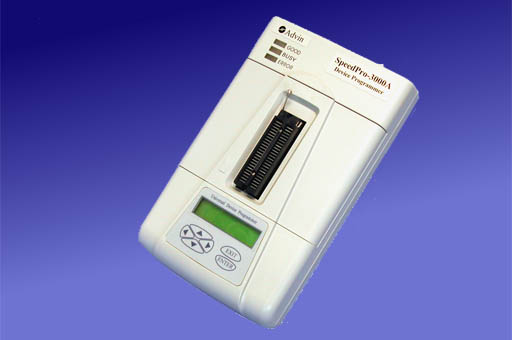

48 pin universal pin-drivers support all types of DIP devices from 8 to 48 pins
with no need for specific device adapters.
Non-DIP devices are supported by universal adapters.
For example, one 44-pin TQFP adapter can be used for different kinds
of 44-pin TQFP devices.
Software programmable I/O levels allow support for low voltage devices
down to 1.5V.
Expandable to 100 pin-drivers with the optional expansion module, PEP3000A.
Universal pin-driver architecture makes new device algorithms easily
available since no specific socket adapters need to be made (for devices
up to 100 pins).
Fastest low-cost programmer in the market
Programs high-density flash memory devices at near-theoretical minimum programming
times.
Programs Intel 28F320W18 (1.8 volts 32Mbit) at 18 seconds (13 sec for program
and 5 sec for verify).
Advanced hardware features
Advanced hardware design minimizes ground bounce noise and allows
programming of super-low-voltage devices reliably.
Only IC manufacturer approved programming algorithms are used.
+/- 5% and +/- 10% Vcc verification enhances programming reliability.
Supports 40,000+ devices
Device types supported include EPROM, flash, micro, and logic.
Devices are being added continuously. Priority for new devices
are taken from customers who made device requests.
Free software updates can be downloaded via Internet at any time.
Designed for multi-mode applications
Convenient PC-controlled operation for the R&D and engineering.
environment.
Stand-alone operation is provided by a built-in keyboard and LCD display.
(Requires optional Compact Flash Card for storing programming algorithms
which are downloaded from PC to programmer. Once the programming algorithms
are stored in the Compact Flash Card, the programmer can be operated without
connection to a PC.)
Easy-to-use Windows based S/W
Microsoft Windows 98/Me/NT/2000/XP compatible
Pin continuity and reverse insertion checks help to prevent devices
from accidental damage.
Over-current and over-voltage protection ensures safety of the
devices and programmer hardware.
Auto-program command combines device operations like program, verify, security
into a single command at any user-selected sequence.
Project function simplifies operations. Settings such as device selection,
file selection, device configuration, program options can be saved into
project files, thus reducing multiple steps into a single operation.
The auto-start feature allows programming to start automatically
as soon as a chip is inserted.
Automatically recognizes file formats and detects large file offsets.
Serialization function allows serial numbers to be generated and programmed
automatically.
Ideal for high-volume manufacturing
Putting multiple units together in stand-alone mode
creates a multi-site concurrent programming environment for volume
production. The advantages, over a traditional
gang programmer, are:
Flexible and expandable: start with one unit and add more
units as the need arises.
Less downtime: in case of a failure of one unit, other units
can continue to operate.
Concurrent programming: each chip begins to be programmed as soon
as it is inserted into a socket.
SPECIFICATIONS
DEVICE SUPPORT
Device Types Supported:
EPROM, Paged EPROM, Parallel and Serial EEPROM, FPGA Configuration
Serial PROM, FLASH Memory (NOR and NAND), Bipolar PROM,
NOVRAM, SPLD, CPLD, EPLD, Firmware HUB,
Microcontroller, Microchip PIC, MCU, Standard Logic, etc.
Device Packages Supported on Standard Equipment:
DIP, SDIP.